

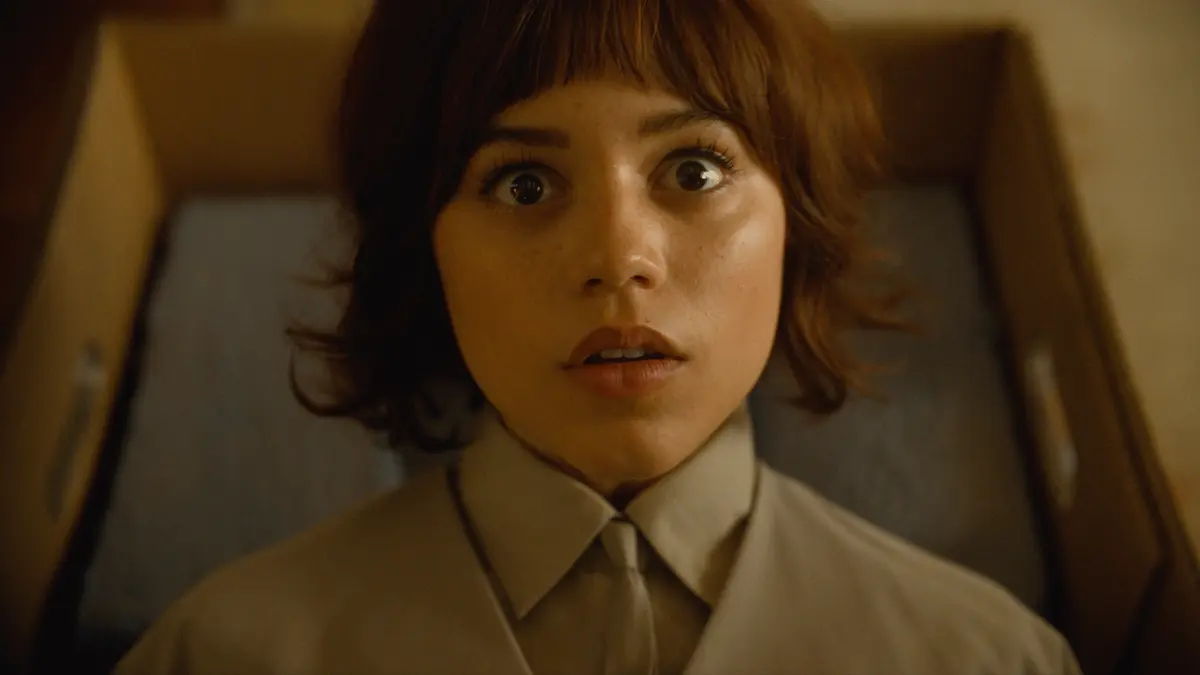
Sony Pictures has released the first trailer for Klara and the Sun, a sci-fi drama directed by Taika Waititi and based on Kazuo Ishiguro’s bestselling novel. The trailer offers a poignant glimpse into a near-future world where advanced artificial companions are designed to alleviate human loneliness. Jenna Ortega stars as Klara, a solar-powered Artificial Friend who begins to develop a deep sense of empathy and emotional understanding while caring for a sick child.
The trailer opens with serene shots of a sunlit room, where Klara (Ortega) powers up by absorbing solar energy. We see her purchased by a mother (Amy Adams) for her daughter Josie, played by Mia Tharia. Josie is suffering from a mysterious, worsening illness, and Klara’s primary role is to offer companionship and comfort. As Klara becomes integrated into the family, she observes the subtle dynamics of human relationships—the fear of loss, the ache of loneliness, and the unspoken bonds of love. The visuals are ethereal, blending everyday domesticity with a sleek, minimalist aesthetic that hints at an advanced, yet unsettling, future.
Director Taika Waititi, known for his eclectic filmography that ranges from the irreverent comedy What We Do in the Shadows to the heartfelt Jojo Rabbit and the action-packed Thor: Ragnarok, brings his signature blend of humor and pathos to this adaptation. Waititi has described the project as a deeply personal exploration of what it means to be human and how love can transcend both organic and artificial forms. In an interview, he noted, “Klara is not just a machine; she’s a mirror for our own vulnerabilities. The story asks whether artificial intelligence can truly bridge the gap between people, or if it only exposes the depths of our own isolation.”
The Source Material: Kazuo Ishiguro’s Vision
Published in 2021, Klara and the Sun is Nobel Prize winner Kazuo Ishiguro’s eighth novel. It was met with critical acclaim for its tender, philosophical take on artificial intelligence and the nature of love. The story is told from Klara’s limited but increasingly perceptive perspective. She observes the world not with human biases but with a kind of naive clarity, making her a unique narrator. The novel explores themes of social inequality, as only wealthy families can afford Artificial Friends, and the ethical implications of creating beings programmed to serve emotional needs. Ishiguro also delves into the concept of the “sun” as a source not only of power but of spiritual life for Klara, adding a quasi-religious dimension to her existence.
Ishiguro previously touched on similar themes in Never Let Me Go, which was adapted into an acclaimed film in 2010 starring Carey Mulligan. That story focused on clones bred for organ donation, questioning what it means to have a soul. Klara and the Sun continues this exploration but with a gentler, more hopeful tone. The novel was a bestseller and shortlisted for the Booker Prize, solidifying Ishiguro’s reputation as a master of speculative fiction with deep emotional resonance.
The film adaptation has been in development since 2021, with Dahvi Waller (known for Mad Men and Mrs. America) writing the screenplay. Ishiguro serves as an executive producer, ensuring the film stays true to the novel’s core themes. The producer team includes David Heyman, Garrett Basch, and Taika Waititi himself, via his production company Piki Films.
Cast and Performances
Jenna Ortega leads the cast as Klara, continuing her meteoric rise in Hollywood. Since her breakout role as Wednesday Addams in Netflix’s Wednesday, Ortega has become one of the most sought-after young actors. She recently starred in Death of a Unicorn, Hurry Up Tomorrow, and The Gallerist, showcasing her versatility across horror, drama, and comedy. For Klara and the Sun, Ortega underwent extensive preparation, studying motion and voice modulation to portray an AI character believably. In the trailer, her performance captures both the mechanical precision of a robot and the subtle evolution of an awakening consciousness.
Amy Adams plays the mother, a role that requires her to convey grief, hope, and fierce maternal love. Adams is a six-time Oscar nominee known for Arrival, Vice, and Sharp Objects. Her ability to embody complex emotional landscapes makes her an ideal choice for this layered character. Natasha Lyonne, Steve Buscemi, and Aran Murphy round out the supporting cast. Lyonne brings her characteristic dry wit and warmth, while Buscemi adds an unpredictable edge. Aran Murphy, son of actor Cillian Murphy (Oppenheimer), makes his feature film debut, adding a dose of fresh talent.
Themes and Visual Style
The trailer’s visual language emphasizes contrast: the warmth of sunlight versus the sterile interiors of a controlled environment, organic human fragility versus sleek metal and glass. Cinematography by Lawrence Sher, who worked with Waititi on Joker (though Sher was not on that film, he is a frequent collaborator on other projects), uses natural light to underscore Klara’s solar dependency. The score, composed by Michael Giacchino, blends electronic pulses with orchestral swells to mirror Klara’s internal journey.
A major theme is the ethics of artificial companionship. In the world of the film, Artificial Friends are marketed as solutions to loneliness, but they raise unsettling questions: Can love felt for an AI be real? Is it ethical to create beings that cannot truly consent to their roles? The trailer hints at these dilemmas through a haunting line from Klara: “I have learned that the sun gives life, but it also takes it away.” This resonates with Josie’s illness and the uncertain fate of their bond.
Another underlying theme is class division. The novel explicitly shows that only affluent families can afford an Artificial Friend like Klara, while poorer families are left without such resources. The film is expected to subtly critique socioeconomic disparities through character interactions and world-building details. Waititi has a history of weaving social commentary into his films, from the Nazi satire of Jojo Rabbit to the indigenous perspectives in Boy and Hunt for the Wilderpeople.
Release and Anticipation
Klara and the Sun is scheduled for theatrical release on October 23, 2026, positioning it as a potential awards contender. With a November release typical for prestige films, the October date is early but still within the fall festival season. The film may premiere at festivals like Venice or Toronto in late summer. Given the strength of the source material and the cast, early buzz is high. The trailer has generated significant social media discussion, with many praising Ortega’s uncanny portrayal of an AI and the hauntingly beautiful visuals.
For Taika Waititi, this project marks a return to more serious, character-driven storytelling after the blockbuster demands of the Marvel Cinematic Universe and the comedic Our Flag Means Death. It will be interesting to see how his signature irreverence integrates with the melancholic tone of Ishiguro’s novel. The teaser suggests a careful balance, with moments of gentle humor that feel organic rather than forced.
As the release date approaches, more marketing materials will likely deepen the exploration of Klara’s world. For now, the trailer has succeeded in capturing the novel’s essential question: In an age of technological connectivity, can artificial bonds ever truly replace human ones? The answer, as Klara herself might say, lies in the light.
With a talented team, a beloved source, and timely themes, Klara and the Sun is shaping up to be one of the most thought-provoking sci-fi films of 2026. Audiences can expect a cinematic experience that is as visually stunning as it is emotionally resonant.
Source:The Hindu News