

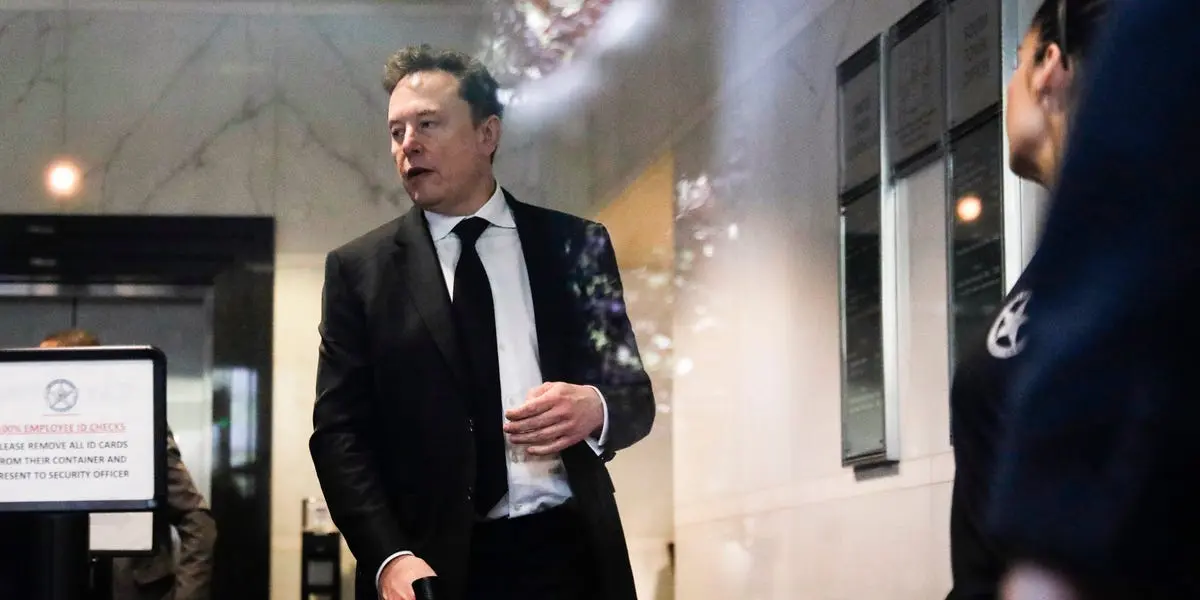
The trial over OpenAI has begun, kicking off a showdown between Elon Musk and Sam Altman. Musk, the CEO of Tesla, took the witness stand on Tuesday afternoon and testified about his early career and falling out with Google's Larry Page over AI talent. He's expected back on Wednesday.
At the heart of the case is Musk's accusation that OpenAI founders, including CEO Sam Altman, who also showed up at court Tuesday, deceived him into donating $38 million to OpenAI based on promises that it would remain a nonprofit dedicated to developing AI for the public's benefit, and not for private gain. The trial pits two of the most powerful tech titans against each other. Musk is asking for up to $134 billion in damages and for Altman to lose his job, among other potential remedies.
Musk's testimony: A walk through his history
Musk opened his testimony saying that a verdict siding with OpenAI would greenlight the 'looting' of American charities. He told the jury he had "$100,000 dollars in student debt" before being able to profit from his first company, Zip2. The jury likely knows the CEO of Tesla and SpaceX as the world's richest man with an estimated net worth of around $780 billion, according to Forbes.
After telling the jury about serving as CEO of both Tesla and SpaceX, Elon Musk explained how he does it all: He doesn't take a break. "I technically work 80 to 100 hours a week," Musk said. "I don't have vacations, I don't have vacation homes. I just want to build businesses that make people's lives better." Musk's companies additionally include brain technology company Neuralink and the tunnel-drilling Boring Company. The serial CEO also has at least 14 children.
AI fears and the Obama meeting
Musk testified that he met one-on-one with then-President Barack Obama in 2015 and used the time to warn him about the dangers of AI. Instead of seeking favors for his companies, Musk said he spent an hour with Obama focused on the risks AI could pose. He compares AI to a very smart child, but one that could "blow up" and run out of control if we're not careful. As such, Musk says it's important to "instill the right values" in the child.
"That has been my long standing concern about AI, which is what happens when the computer gets much smarter than humans?" Musk adds.
The rivalry with Google
Musk says that it took him "an immense amount of effort" and that "it was extremely difficult" to recruit AI researcher Ilya Sutskever from Google to work for OpenAI. "Larry Page refused to speak to me ever again," Musk says. The effort to recruit Sutskever took four to five days of back-and-forth in convincing him to leave while Page tried to convince Sutskever to stay, Musk adds. He calls Sutskever the "most important" researcher who contributed to the existence of OpenAI. Sutskever no longer works at OpenAI, leaving to start his own AI lab in 2024 in the wake of Sam Altman's brief ousting as CEO.
Elon Musk testified that Google cofounder Larry Page called him a "speciest" for being "pro-humanity" over AI. It's an exchange we've heard about before. Musk and Sam Altman founded OpenAI, in part, as a counterweight to Google's artificial intelligence initiative, DeepMind. They wanted cutting-edge AI to benefit all of humanity and not remain in the hands of a company, Musk has said in court documents.
OpenAI's origins and the for-profit shift
Musk tells the jury that he planned from the beginning for OpenAI to be a 501(c)(3) charitable organization that would "aim to bring in more money than it spends." A charity, rather than a for-profit company, would crystallize its mission of developing artificial intelligence, he says. "I don't want to fund OpenAI to make safe AI, and then find out it was making unsafe AI," Musk adds.
Questioning turned to OpenAI's 2015 origins. Musk says the name OpenAI emerged from discussions with Sam Altman and other founders. "The 'open' in OpenAI represents open source," says Musk. Musk and his lawyer, Steven Molo, are looking at email exchanges showing that Musk, at the time, proposed a five-person board for OpenAI consisting of himself, Altman, Bill Gates, Pierre Omidyar, and Dustin Moskovitz, whom he refers to on the stand simply as "Zuckerberg's roommate."
Elon Musk tells jurors that he was open to a "small for-profit that would provide funding for the nonprofit" during OpenAI's internal talks about the matter between 2017 and 2018. He says he made it clear that the nonprofit had to remain in control. "As long as the tail didn't wag the dog, I think," Musk testifies.
Legal arguments: Opening statements
In his opening statements, Elon Musk's attorney, Steven Molo, explained how the Tesla CEO provided tens of billions of dollars for "OpenAI to get up and running off the ground." "Without Elon Musk, there will be no OpenAI," Molo told the federal jury. Musk helped found the ChatGPT maker in 2015, together with OpenAI CEO Sam Altman and company president Greg Brockman, who is also a defendant in the case.
OpenAI, founded as a nonprofit AI research lab, "broke every promise" when it became "a for-profit operation for the good of the defendants," Elon Musk's attorney, Steven Molo, told the jury in his opening remarks. Last year, OpenAI completed a major restructuring that shifted the company toward a more conventional for-profit structure. It's now valued at over $800 million and is reportedly working toward an IPO that could take place this year.
Sam Altman's attorney, William Savitt, told the jury in his opening statements that the evidence will show Elon Musk tried to take control of OpenAI. Savitt said Musk "demanded control" of the AI firm and used his bankrolling of it to put "a financial gun to the head of other founders." Musk alleges he invested tens of millions in seed money to OpenAI over the years, only to be "betrayed" by Altman and other executives.
William Savitt, representing Sam Altman and OpenAI, spent his opening statement batting away Elon Musk's claims that his $38 million in charitable donations came with conditions. "The question is whether OpenAI made specific promises to Musk when he made his donations," Savitt said. "And the answer to that is no."
Microsoft's role and defense
Elon Musk's lawsuit alleges OpenAI effectively became part of Microsoft through the tech giant's investments in the artificial intelligence firm, which began in 2019. Russell P. Cohen, an attorney representing Microsoft, spent his opening arguments trying to rip this logic apart. Microsoft wasn't going to invest billions of dollars for "charity," Cohen said. "OpenAI retained control of its technology and control of the company, and you're going to hear from Mr. Nadella that this is a win-win," said Cohen, referring to Microsoft CEO Satya Nadella. "Unlike Mr. Musk, Microsoft never tried to control OpenAI."
The crux of OpenAI's case is that Elon Musk is trying to take down a rival. Musk is the founder of xAI, the company behind the Grok chatbot. On Tuesday, Microsoft's lawyer told the jury that Musk was suing because he had "fallen behind" in the AI race. "He launched xAI, and then he sued." In an effort to compete, Musk has poured billions into xAI, integrated Grok into X, and leveraged his broader tech empire to scale the platform quickly.
Courtroom atmosphere and further insights
Here's what the layout looks like in the Oakland, California, federal courtroom, according to a sketch from Business Insider reporter Katherine Li. From the perspective of journalists and other members of the audience in the gallery, Elon Musk and his legal team have a big table on the left, and Sam Altman's and OpenAI's legal team sit on the right. The lawyers are sitting on what is known in the legal parlance as "rolly chairs." The courtroom is filled to the brim, and there's a dog at the back of the room, near the entrance, keeping everyone safe.
The line to get into witness the epic showdown was so long, it went out the front doors of the Oakland federal courthouse. Business Insider reporter Katherine Li waited in the line earlier Tuesday with lawyers, press, and what appeared to be members of the public, before getting inside just in time for opening arguments. On Monday, the outside of the courthouse was overflowing with protesters, including a guy dressed in a robot suit with a sign that read: "Altman's AI enslaver."
Already, this case has led to a treasure trove of private emails and other documents, including text messages showing Musk asking Meta's Mark Zuckerberg to join him in an unsolicited bid for OpenAI's intellectual property. Earlier on Tuesday, employees at MoloLamken, a firm representing Elon Musk, were spotted wheeling boxes of documents into the Oakland courthouse.
Nine jurors will be deciding whether OpenAI is liable in the trial. If OpenAI is found liable, US District Judge Yvonne Gonzalez Rogers will be deciding the remedies in a separate phase. As previously reported, Judge Gonzalez Rogers is considered tough but fair. Musk has asked her to reverse the transformation of OpenAI's for-profit arm and disgorge it of "ill-gotten gains."
Ahead of the trial's opening arguments, Elon Musk boosted the visibility of a New Yorker magazine investigation about Sam Altman. The New Yorker story examined claims that Altman had been dishonest in business dealings and in running OpenAI — claims that dovetail with Musk's lawsuit. On Musk's social media network X, formerly Twitter, a post from one of the article's co-authors Ronan Farrow was labeled as "Boosted" and said, "This organic post was boosted by @elonmusk."
Photogs have already captured Elon Musk, the world's richest man and CEO of Tesla, entering the Ronald V. Dellums Federal Building in Oakland, California, where his civil case is underway. The lawyers will kick off the trial with opening arguments, followed by the witnesses. Musk could be the first witness in his $134 billion case against Sam Altman and OpenAI, which he helped start in 2015.
After two hours of hearing Elon Musk on the witness stand, the jury is going home. Musk is due back in court on Wednesday for more direct examination from his lawyer, Steven Molo, followed by cross-examination, likely from OpenAI's and Sam Altman's lawyer, William Savitt. US District Judge Yvonne Gonzalez Rogers, who is overseeing the case, said Musk isn't allowed to speak to his attorneys overnight. The jury trial is expected to take three weeks overall.
Source: Business Insider News