

Should You Buy the Vision Pro?
The Apple Vision Pro, priced at $3,500, is a significant investment that may deter many consumers. Reviews indicate that it is a device that might not integrate seamlessly into existing workflows for most users. Some individuals have expressed regret over their purchase, despite its strong capabilities for enjoying movies, viewing 3D videos, and functioning as a display for a Mac. Users often struggle to find daily applications for the headset.
Weighing over 1.3 pounds, the Vision Pro can become uncomfortable over extended use. Apple has enhanced comfort with the introduction of the Dual Knit Band, launched alongside the M5 chip. The headset's external battery pack complicates travel, particularly when using Apple's Travel Case.
While the Vision Pro represents Apple's most technically sophisticated offering and showcases impressive engineering, potential buyers should test it at an Apple Store and conduct thorough research on its capabilities before committing to a purchase. Although it excels in content consumption and can serve as a Mac display, the selection of apps and games is relatively limited.
With the release of the M5 chip in October 2025, now may be a good time to buy, as another update is not anticipated for at least two years, and the development of the next-generation headset is reportedly on hold.
- M2 vs. M5 Vision Pro: 20+ Differences Compared
Apple Vision Pro
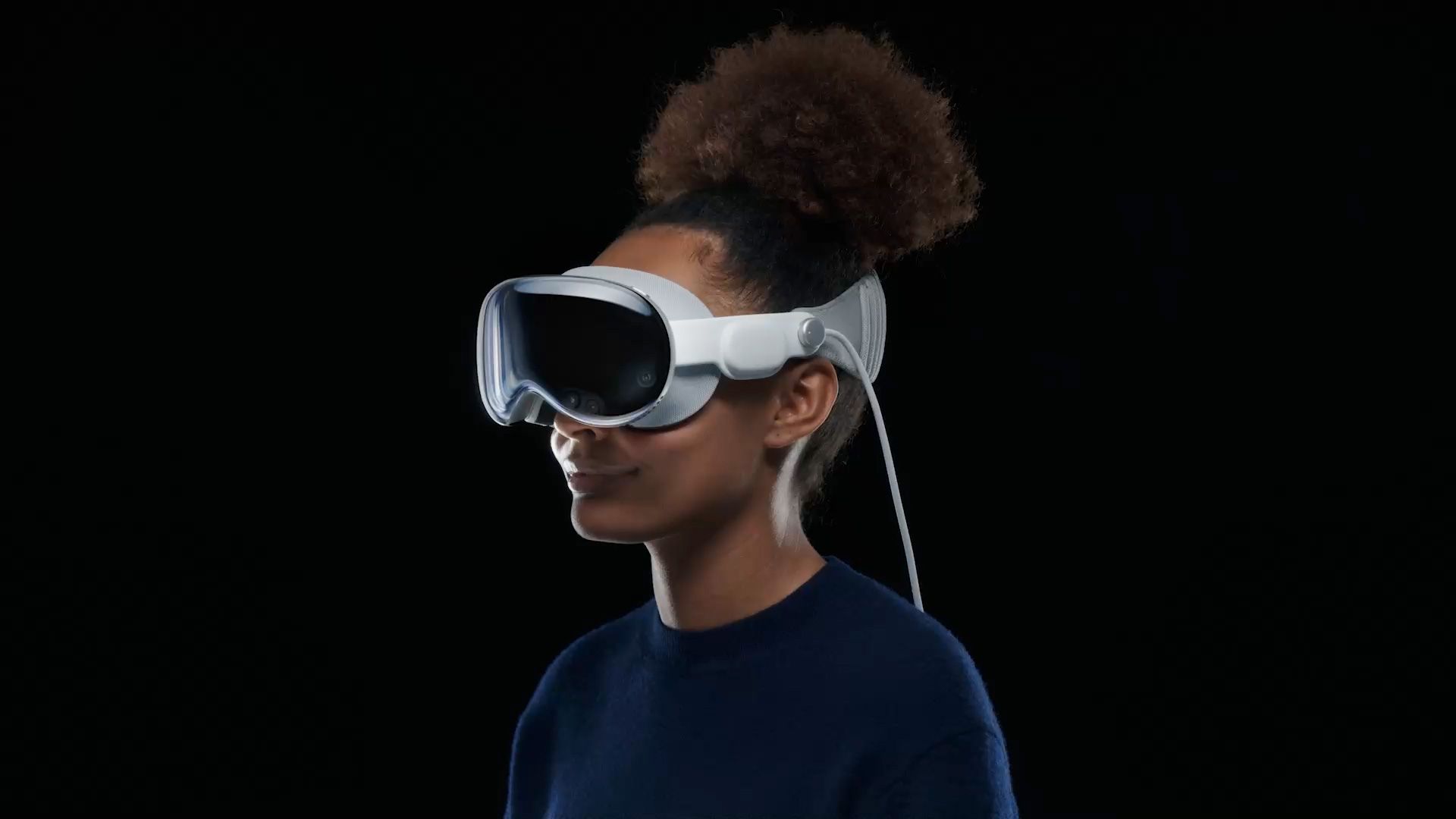
The Apple Vision Pro is a pioneering augmented and virtual reality headset, representing Apple's first major entry into a new product category since the 2015 Apple Watch. The original version launched in February 2024, followed by an updated version featuring the M5 chip in October 2025.
While classified as a headset, Apple prefers the term spatial computer to highlight its ability to integrate digital content with the physical world. The Vision Pro is the first device in the spatial computing category.
It functions as a mixed reality headset, displaying augmented reality content over the user's environment and offering immersive virtual content. However, unlike some AR devices, the Vision Pro does not allow users to see their surroundings; everything viewed is digital. For augmented experiences, Apple employs cameras to map the user's environment, translating reality into a digital layer enhanced with virtual elements.
For a fully immersive virtual reality experience, the cameras are disabled, allowing users to concentrate entirely on the headset's display. This transition between reality and immersion is facilitated by an on-device Digital Crown.
The design of the Vision Pro resembles high-end ski goggles, featuring a laminated glass front integrated into an aluminum alloy frame. A soft, fitted Light Seal attaches magnetically to conform to the user's face, blocking out external light.
Equipped with two Audio Straps housing built-in speakers, the headset delivers Spatial Audio, blending audio from the headset with real-world sounds. The M5 model includes a new Dual Knit Band designed for greater comfort and weight distribution.
Inside, two micro-OLED displays provide over 4K resolution to each eye, amounting to a total of 23 million pixels. The external display, known as EyeSight, projects an image of the user's eyes, indicating whether they are in immersive or augmented reality mode. Prescription Zeiss Optical Inserts can be magnetically attached for glasses wearers.
Control is achieved through eye tracking, hand gestures, and voice commands, eliminating the need for physical controllers. Users can navigate apps by looking at them and tapping their fingers to select.
The Vision Pro houses more than a dozen cameras and sensors to monitor the environment and user interactions, utilizing Optic ID for secure authentication through iris scanning.
It features two Apple silicon chips: the M5, which powers the device, and the R1 chip, dedicated to processing inputs from cameras, sensors, and microphones. The Vision Pro can capture 3D photos and videos using its built-in camera.
To maintain a lightweight design, the headset does not include an internal battery; instead, it is powered by an external battery worn at the hip or via a wall adapter, offering up to 2.5 hours of use.
With the Vision Pro, users can arrange apps and windows in mid-air, creating an “infinite canvas”. The device runs on visionOS, featuring a dedicated App Store for Vision Pro apps alongside compatibility for iPhone and iPad apps.
The Home View displays favorite Apple apps, with data synchronized via iCloud. Users can experience immersive entertainment, including over 150 3D titles on Apple TV.
The redesigned FaceTime allows for collaborative features and enhances social interaction through spatial audio cues.
The Vision Pro is available for purchase in select countries, starting at $3,500 for 256GB of storage. Customers must undergo a Face ID scan for proper fitting.
What's in the Box
Included in the Vision Pro package are a Dual Knit Band, Light Seal, two sizes of Light Seal Cushions, an Apple Vision Pro Cover, a Polishing Cloth, a battery, a USB-C charging cable, and a power adapter.
No Trade-Ins
Apple does not offer trade-in options for the Vision Pro, including the previous M2 model.
Vision Pro Reviews
Reviewers have praised the comfort provided by the Dual Knit Band, which alleviates pressure on the face and neck. Although weight distribution has improved, it remains noticeable after extended use. Performance with the M5 chip shows marked enhancements, with a consistent experience free from lag and stuttering.
The increase in pixel rendering and support for 120Hz refresh rates yields smoother visuals, contributing to an overall enhanced user experience.
How It Works
The Vision Pro is designed as a mixed reality headset, capable of displaying both augmented and virtual reality content. It leverages exterior and interior cameras to map surroundings while providing the option to create immersive experiences.
Design
With a design akin to ski goggles, the Vision Pro utilizes a laminated glass front and a flexible Light Seal for comfort. Two audio straps enhance the audio experience, and the adjustable Dual Knit Band improves stability.
Display
Each eye benefits from a custom micro-OLED display offering superior resolution and a smoother refresh rate compared to its predecessor. The EyeSight display serves to indicate the wearer's visual state to others.
Cameras and Sensors
The Vision Pro features multiple cameras and sensors for an immersive experience, ensuring accurate hand tracking and real-time 3D mapping.
Audio
The integrated speakers provide a spatial audio experience, and the headset supports connections with AirPods for enhanced sound quality.
Connectivity
Support for Wi-Fi 6 enables efficient connectivity, though it does not include the newer Wi-Fi 6E technology.
Battery Life
Improved battery performance allows for up to 2.5 hours of general use, with options for extended power through additional battery packs or wall adapters.
visionOS
visionOS offers a 3D interface, allowing users to arrange apps dynamically in their virtual space. The operating system supports a variety of navigation methods and integrates seamlessly with Mac.
What's Next for Vision Pro
Future developments may include lighter models and smart glasses, focusing on expanding Apple's presence in AR and VR technology.
Source: MacRumors News