

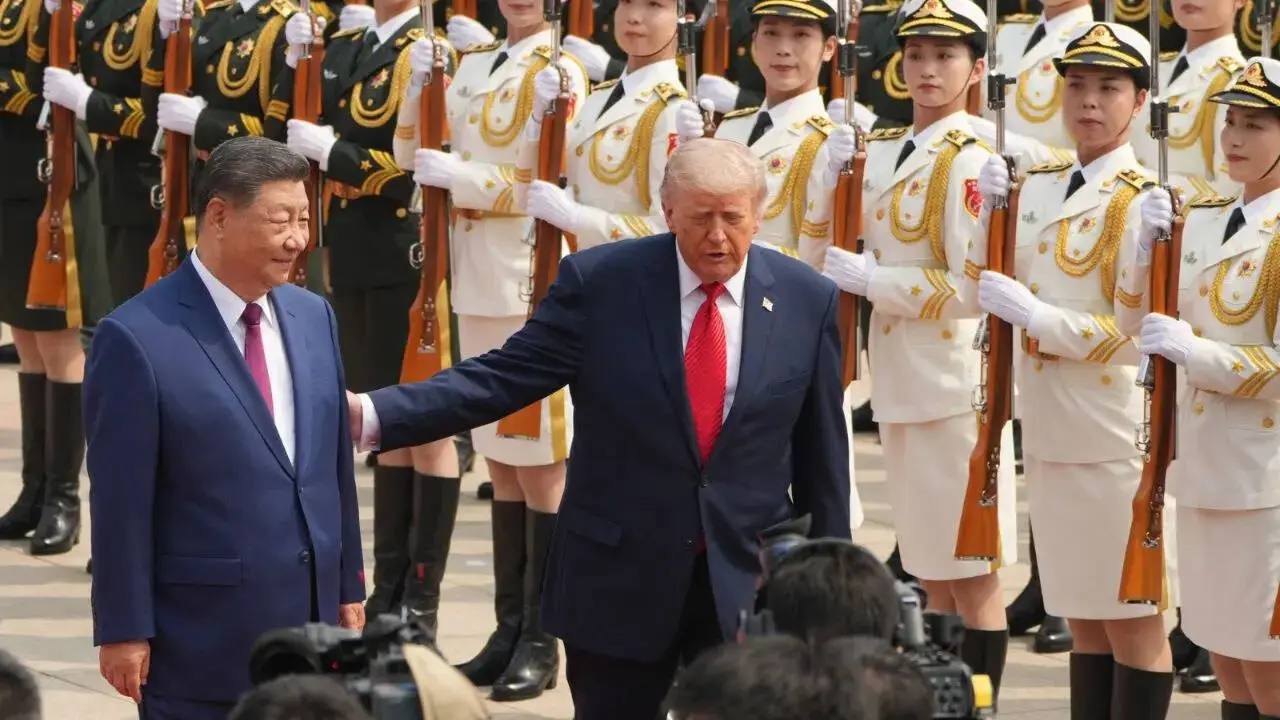
Beijing: Chinese President Xi Jinping issued a stark warning to US President Donald Trump during their bilateral meeting at the Great Hall of the People on Thursday, stating that differences over Taiwan could lead to 'clashes or conflict' between the two powers. The warning, reported by Chinese state media, underscored the fragility of US-China relations as the world's two largest economies grapple with a range of geopolitical and economic challenges.
The Trump-Xi summit, which began with a formal welcome ceremony featuring a 21-gun salute and military honours, marked Trump's first official visit to China since 2017. The two leaders held closed-door talks covering a broad agenda that included the ongoing war in Iran, global trade tensions, technology restrictions, and artificial intelligence cooperation. Senior US business executives, including Tesla CEO Elon Musk, Nvidia chief Jensen Huang, and Apple CEO Tim Cook, accompanied Trump to Beijing, expressing optimism about discussions with Chinese counterparts.
Taiwan: The Core Flashpoint
Xi's remarks on Taiwan formed the most pointed moment of the summit. He emphasised that the island, which Beijing considers a breakaway province, remains the 'most important and sensitive core issue' in Sino-American ties. Washington maintains unofficial but robust political and military support for Taipei, a policy that has long angered Beijing. The Chinese president warned that any miscalculation on Taiwan could trigger a direct confrontation, urging Trump to adhere to the One-China principle and reduce US support for the island's defence.
Trump did not publicly respond to Xi's warning during the meeting, but US officials have indicated that Washington will continue to emphasise stability and deterrence in the Taiwan Strait. The issue is expected to remain a central point of contention in future relations, with Beijing pushing for reduced US arms sales and political engagement with Taiwan.
Iran War and Energy Security Dominate Discussions
The conflict involving Iran was a major focus of the talks. Trump is believed to have pressed Xi to use China's influence with Tehran to help reopen the Strait of Hormuz, a critical chokepoint for global oil shipments. The US blockade of Iranian ports has disrupted energy supplies and driven up oil prices, impacting both economies. China, which relies heavily on Middle Eastern oil, has publicly called for a ceasefire and renewed negotiations, while avoiding direct involvement in the crisis.
Beijing has also criticised the US blockade and continued to import Iranian crude through various channels, drawing accusations from Washington that Chinese firms are indirectly supporting Iran's war effort. Chinese officials have downplayed their influence over Tehran, but analysts believe China's role is crucial for any diplomatic resolution.
Trade and Economic Relations: A Cautious Return to Dealmaking
Economic issues were high on the agenda, with both sides discussing a possible extension of the existing trade truce. Trump's visit comes amid renewed tariffs and technology restrictions imposed during his first term, many of which remain in place. The White House indicated that Trump expected to bring home 'good deals' that would rebalance trade with China while protecting American workers and farmers.
Potential agreements include increased Chinese purchases of US goods, such as Boeing aircraft, agricultural exports, and energy products. However, analysts caution that major breakthroughs are unlikely, given the deep structural tensions in the relationship. Both leaders face domestic economic pressures — inflation and slowing growth in the US, and a property crisis and weak consumer demand in China — which complicate negotiations.
Artificial Intelligence and Technology Competition
The summit also touched on artificial intelligence, where the two countries are locked in a fierce rivalry for technological supremacy. Discussions covered risk management, regulation, and the strategic implications of emerging technologies. The presence of top tech executives in Trump's delegation signalled US interest in maintaining access to the Chinese market while protecting sensitive intellectual property.
China has made AI a national priority, investing heavily in research and development. The US has imposed export controls on advanced semiconductors and other technologies, aiming to slow China's progress. Both sides agreed to continue high-level dialogue on AI safety and governance, though concrete agreements were not announced.
Additional Issues: Fentanyl, Hong Kong, and Nuclear Expansion
The agenda also included tangential issues such as fentanyl trafficking, the case of Hong Kong activist Jimmy Lai, China's nuclear weapons expansion, and tensions in the South China Sea. On fentanyl, the US has pressed China to crack down on the production and export of precursor chemicals used in illicit synthetic opioids. China has taken some steps but Washington wants more action.
The case of Jimmy Lai, the pro-democracy media tycoon jailed in Hong Kong, remains a symbol of Beijing's tightening control over the territory. US officials have called for his release, but China views the matter as an internal legal issue. On nuclear weapons, China has been expanding its arsenal rapidly, raising concerns in Washington about strategic stability. The South China Sea disputes, involving competing claims among multiple nations, also featured in the discussions, with the US reaffirming freedom of navigation.
Ceremonial Diplomacy and Symbolism
The summit was punctuated by symbolic gestures and ceremonial events. Trump and Xi visited the historic Temple of Heaven, a 600-year-old imperial complex in central Beijing, and posed for photographs. Trump described the talks as 'great' and said the relationship between the US and China would be 'better than ever before.' Xi told Trump that 'the whole world is watching' their meeting, and called for a stable relationship that avoids the 'Thucydides Trap' — a reference to the danger of conflict between an established power and a rising power.
Later, Xi hosted a state banquet for Trump at the Great Hall of the People, followed by a tea session and lunch on the second day of the visit. The extensive courtesies reflected China's desire to manage tensions while projecting an image of benevolence.
Limited Expectations for Major Breakthroughs
Despite the high-profile nature of the meeting, analysts expect modest outcomes rather than sweeping agreements. The most likely results include limited economic deals, an extension of the current trade pause, and commitments to continue high-level dialogue throughout 2026. The summit is widely viewed as a test of whether Washington and Beijing can manage their strategic rivalry without destabilising the global economy and geopolitical order.
Both leaders face significant domestic pressures. Trump is navigating an election year at home, while Xi is dealing with a slowing economy and social unrest. The need to show results may push both sides toward incremental progress, but deep-seated mistrust and competition over technology, influence, and regional security will persist. The world watches to see if the two giants can coexist peacefully in an increasingly volatile international environment.
Source: Times Now News