

Hong Kong pro-democracy protest leaders pledged to stay on the streets Wednesday in a bid to keep pressure on the government ahead of already fraught talks on political reform. The vow came as numbers at demonstration sites around the city dwindled to a few hundred after days of mass rallies that had drawn tens of thousands. Police said Wednesday they were deploying negotiators to try to persuade protesters to leave the barricades, but student leader Lester Shum insisted they would stay.
Determination Amidst Dwindling Numbers
“We have reached the stage of dialogue and we will be persistent in our civil disobedience campaign and stay on the streets,” said Shum, a key figure in the student-led movement. Leader of the pro-democracy Occupy movement, Chan Kin-man, added: “Only if the government quickly take action and give a concrete response to students’ demands (for democracy) will the problem be resolved.” The statements came as the city braced for formal talks set for Friday between students and Chief Secretary Carrie Lam, the deputy to Hong Kong’s embattled leader Leung Chun-ying. Pro-democracy leaders had earlier agreed to a dialogue with Lam but called it off last Friday after what they described as “organised attacks” on protesters at the Mong Kok demonstration site.
Background of the Protest Movement
The protests, which began in late September 2014, marked one of the most significant challenges to Hong Kong’s government since the handover from British rule in 1997. The immediate trigger was Beijing’s decision to require that all candidates for the 2017 chief executive election be vetted by a nominating committee dominated by pro-establishment figures. Protesters demanded “true democracy” and the right to nominate candidates through a process known as civil nomination. The movement, often called the Umbrella Movement for the umbrellas used to shield against pepper spray, drew parallels to other global pro-democracy uprisings. It was characterized by student-led occupations of key intersections in Admiralty, Mong Kok, and Causeway Bay.
Government Response and Negotiation Efforts
The authorities have given no indication of concrete plans to clear the protest sites and reopen roads, despite traffic gridlock and truncated bus routes. Ray Lau, deputy secretary for mainland and constitutional affairs, said the government was “very sincere about organising this meeting and dialogue.” But he added there were “many difficulties ahead,” with disagreements over arrangements including the venue and whether there should be a mediator. Police have adopted a generally restrained approach, though there have been clashes with protesters. “(With) all the obstacles on the road, we have already arranged the police negotiators and the police community relations officers to engage in dialogue with people gathering there,” said Lee Kwok-chung, senior superintendent of traffic police. “We tried to convince them to remove the blockage as soon as possible and, if not, we will continue to monitor the situation and take suitable actions if needed.”
Underlying Discontent Beyond Political Reform
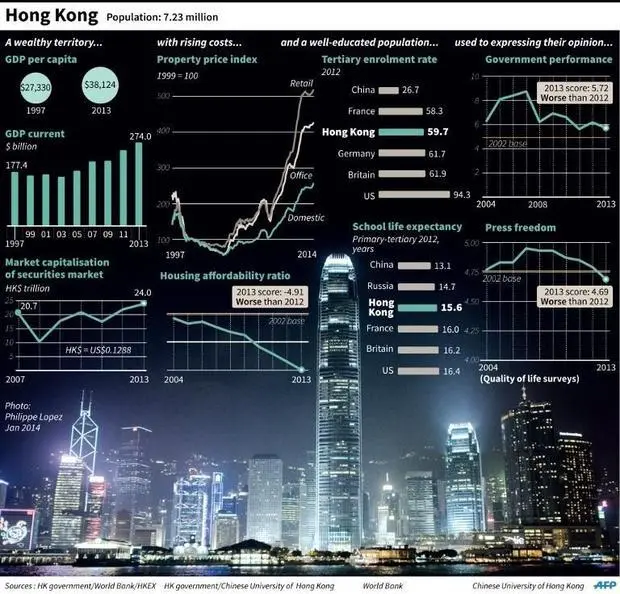
Protesters remain sceptical that talks with the government will achieve any concessions on political reform. Rising social inequality, the soaring cost of living, and distrust of the government are also fuelling discontent, particularly among Hong Kong’s disillusioned youth. The city, long known for its economic vibrancy, has seen a growing wealth gap and housing affordability crisis that have left many young people frustrated. “This is an important spot — we should hold on to this regardless of how many people we have,” said Helix Kwok, an 18-year-old student who was among a dozen protesters camping outside the Chief Executive’s office Wednesday. “If we withdraw, the government will then ignore us. With us here, we can react to anything that happens.” The government complex has been one of the key protest sites and the scene of tense standoffs between police and students, with Wednesday’s opening of parliament called off over security fears.
Voices from the Occupied Sites
Protesters remain both determined and wary. “I’m not very hopeful about the outcome (of talks),” said Timothy Sun, 17, who has spent 10 days at the main Admiralty protest site. “I think the government is going to repeat the same thing as before — instead of accepting our requests such as civil nomination, they say that we’ll have free elections step-by-step. I am going to stay on. I don’t want this protest to be a failure.” Despite the resilience, demonstrators are facing an increasing public backlash as road diversions due to the occupied sites jam the highways and businesses say they are suffering. Some residents have complained about the disruption and called for an end to the protests. Nonetheless, the core of the movement remains committed to peaceful civil disobedience.
Historical Context and International Attention
The protests drew global attention, with many international observers calling for restraint and dialogue. The United Nations, the United States, and other Western governments expressed concern while reiterating respect for China’s sovereignty. China’s central government, however, strongly opposed the protests, accusing outside forces of interference. The Hong Kong government, under pressure from Beijing, maintained that the Basic Law and the decisions of the National People’s Congress must be followed regarding the electoral framework. The standoff highlighted the tension between Beijing’s desire for control and Hong Kong’s aspirations for greater autonomy. Over the following weeks, the protests would gradually wind down, with police eventually clearing the occupied sites in December 2014. But the movement left a lasting impact on Hong Kong’s political landscape, inspiring subsequent pro-democracy campaigns and deepening the divide between pro-democracy and pro-establishment camps.
The Friday talks between student leaders and Chief Secretary Carrie Lam are seen as a critical juncture. Whether they produce any substantial concessions remains uncertain, but the protest leaders have made clear they will not relent until their fundamental demands are addressed. The days ahead will test both the government’s willingness to engage and the protesters’ ability to sustain their campaign in the face of growing fatigue and external pressure.
Source: Digital Journal News