

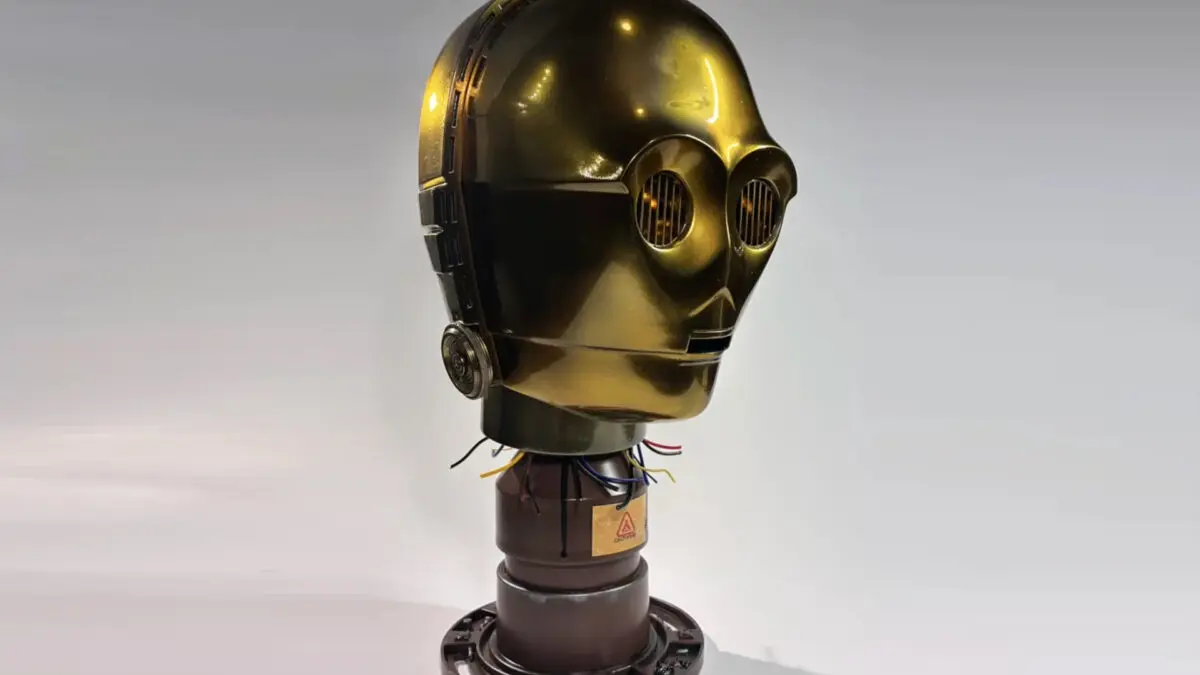
May the fourth be with you, and all that. For Star Wars Day 2026, the spotlight turns to one of the galaxy's most beloved protocol droids: C-3PO. The shiny golden droid with the personality of a maître d' who is absolutely not admitting you to the fancy restaurant—no, I'm afraid not, sir—has long been a fan favorite despite his constant complaints. But now, thanks to a brilliant project by a Chapman University student, you can bring a piece of the Star Wars universe into your living room: a fully functional, AI-powered C-3PO head that talks back to you.
The head was built by Samuel Potozkin, a student at Chapman University in Orange County, California. He recently posted a video detailing the entire process of constructing a DIY C-3PO head that can hold a conversation. The head's speech capabilities are powered by artificial intelligence—specifically, a custom large language model (LLM) imbued with the most prissiest personality from Tatooine. The result is a surprisingly convincing interaction that makes you feel like you're R2-D2, beeping and bleeping in frustration while Threepio prattles on.
The Technical Pipeline
Conceptually, the pipeline is straightforward. Your speech is captured by a microphone connected to a Raspberry Pi 5. The little single-board computer runs a real-time speech-to-text converter. Once it has transcribed your side of the conversation, it sends the text as a prompt to the custom LLM. The LLM's response is then fed through a text-to-speech system designed to emulate C-3PO's distinctive vocal delivery. And with that, you have a chance to experience what it's like to be R2-D2 for a day—constantly listening to polite yet exasperating commentary.
Potozkin provides all the details on his GitHub page, including the code, hardware schematics, and audio processing techniques. One of the most interesting challenges was getting the voice to sound authentic. After testing initial text-to-speech output, Potozkin found that it did not align with the metallic vocal tone associated with C-3PO. So he applied a series of audio post-processing steps that sound more like a guitarist's pedalboard than a typical AI project. As he describes it: “A short delay line was introduced to create tightly spaced temporal reflections, and a chorus effect was applied by slightly modulating the time and pitch of duplicated signal paths, creating the impression of layered vocal resonance.” The result is eerily close to the actual voice actor Anthony Daniels' performance, even when emanating from a disembodied head.
Why C-3PO?
C-3PO has been a staple of Star Wars since the first film in 1977. While R2-D2 is the beloved astromech who saves the day, Threepio is the fussy, protocol-obsessed droid who often provides comic relief and exposition. His head has its own history: the original prop from The Empire Strikes Back—where his head is separated from his body after wandering through the wrong door in Cloud City—sold for over $1 million at auction in 2025, making it one of the most expensive pieces of Star Wars memorabilia ever. Potozkin's project makes a similar artifact accessible to anyone with a 3D printer, a Raspberry Pi, and some soldering skills.
Building a C-3PO head also taps into the growing maker culture and the increasing accessibility of AI. Just a few years ago, creating a conversational AI with a custom personality required a team of engineers and a supercomputer. Now, with LLMs like Llama and GPT-4, and affordable hardware like the Raspberry Pi, a single student can bring a fictional character to life. This democratization of AI is inspiring new forms of creative expression and fan engagement.
Star Wars and AI: A Natural Pairing
The Star Wars franchise has always been fascinated with intelligent machines. From the sarcastic droids to the calculating Imperial probe droids, AI is woven into the fabric of the galaxy far, far away. Real-world projects like this one blur the line between fiction and reality. Potozkin's head is not the first fan-made droid, but it is one of the most sophisticated in terms of conversational ability. Previous efforts focused on animatronics or simple voice playback; this one uses genuine conversational AI to create an interactive experience.
For those interested in building their own, Potozkin's GitHub repository includes everything needed. The hardware list includes a Raspberry Pi 5 (or any similar single-board computer), a microphone, a speaker, a 3D-printed head shell, and some servos for mouth movement if you want full animation. The software stack uses open-source speech recognition and synthesis libraries, along with a fine-tuned LLM that was trained on C-3PO's dialogue from the films. Potozkin also notes that he experimented with different prompt engineering techniques to keep the personality consistent—Threepio should be polite, anxious, and slightly condescending, not a murderous AI.
The response time is impressive: the head starts speaking within a second of you finishing your question. That's crucial for maintaining the illusion of a real conversation. Latency is often the downfall of such projects, but the Raspberry Pi 5's improved processing power, combined with optimized models, makes it feasible.
On May 4, 2026, Potozkin released a video demonstrating the final product. In it, he asks the head various questions about Star Wars, its own preferences, and even about the weather. The head responds in Threepio's characteristic style: rambling, apologetic, and slightly condescending. When asked about R2-D2, it replies with something like, “Oh, that little astromech? Always beeping and whistling. I have to translate everything he says. Most people don't realize how much work that is.” It's pure Threepio and exactly what fans want.
The project has already inspired a wave of similar builds. Forums like Reddit's r/StarWars and r/raspberry_pi are full of people sharing their own attempts. Some are adding motion detection to make the head turn toward the speaker. Others are integrating voice commands to control smart home devices. The possibilities are endless, and Potozkin has open-sourced his work so anyone can contribute improvements.
This is part of a broader trend: AI-powered props and cosplay. At Comic-Con 2025, several builders showcased helmets and masks that could speak in character using similar pipelines. The technology is moving from novelty to mainstream, and Star Wars fans are at the forefront. The C-3PO head is a perfect example of how AI can make beloved characters feel alive in our own homes.
For those not ready to build from scratch, there are hints that commercial versions might follow. Several toy companies have expressed interest in licensing the design. But for now, the DIY community is having a blast. Potozkin's project proves that with some dedication and a bit of code, you can have your own golden droid complaining about your lack of protocol.
The implications go beyond fandom. This type of project teaches practical skills in AI deployment, hardware integration, and audio processing. Students and hobbyists learn about everything from natural language processing to signal processing. It's a hands-on way to understand the cutting edge of technology. And it's fun.
Next May the 4th, you too could make a talking C-3PO head the centerpiece of your annual Star Wars viewing session. All you need is a few weekends, a soldering iron, and a love of proper protocol. What do you make of that idea, R2? Ah. (That's Threepio for “I'll take that as a compliment.”)
Source: Gizmodo News